OUR LADY OF GUADALUPE
MOTHER OF THE TRUE GOD AND STAR OF EVANGELIZATION
THE WOMAN CLOTHED WITH THE SUN BRINGS CHRIST TO THE AMERICAS
Feast: December 12
Readings: Rev 11:19a; 12:1–6a, 10ab and Lk 1:39–47
Introduction
The Feast of Our Lady of Guadalupe celebrates the maternal presence of the Blessed Virgin Mary among the peoples of the Americas. According to the Church’s received tradition, Mary appeared in December 1531 to Saint Juan Diego Cuauhtlatoatzin, an Indigenous Catholic convert, on Tepeyac Hill near present-day Mexico City. Speaking to him with tenderness and respect, she asked that a church be built where people could encounter her Son’s mercy and receive her maternal consolation.
The apparitions occurred during a period of profound suffering. The Spanish conquest had brought political collapse, epidemic disease, cultural disruption, violence, and mistreatment of Indigenous peoples. The missionaries proclaimed Christianity, but the conduct of some colonists seriously contradicted the Gospel.
Into this divided society came an image of Mary whose appearance, clothing, and symbolism spoke powerfully to the Indigenous people while remaining deeply Christian. She did not present herself as a goddess or a replacement for Christ. She identified herself as the Mother of the true God and directed everyone toward her Son.
The feast’s reading from Revelation presents the Ark of the Covenant in heaven and a woman clothed with the sun, with the moon beneath her feet and twelve stars upon her head. The Church applies this imagery to Mary while recognizing that the woman also represents Israel and the Church. Mary embodies the faithful people of God from whom the Messiah comes, while the dragon represents the evil that opposes Christ and his people.
Our Lady of Guadalupe continues to proclaim that God has not abandoned the poor, the displaced, the unborn, the immigrant, or the culturally marginalized. Through Mary, Christ calls divided peoples to reconciliation, conversion, and communion.
Bible Passage (Rev 11:19a; 12:1–6a, 10ab)
God’s temple in heaven is opened, and the Ark of his Covenant becomes visible. A great sign then appears: a woman clothed with the sun, with the moon beneath her feet and a crown of twelve stars upon her head. She is pregnant and cries out in the labor of giving birth.
Another sign appears—a great red dragon that stands before the woman, seeking to devour her child. She gives birth to a son destined to rule the nations. The child is taken up to God and his throne, while the woman receives divine protection in the wilderness.
A heavenly voice announces that salvation, power, the Kingdom of God, and the authority of his Anointed have come.
Gospel Passage (Lk 1:39–47)
Mary travels into the hill country of Judah and enters the home of Zechariah and Elizabeth. When Elizabeth hears Mary’s greeting, the child in her womb leaps, and Elizabeth is filled with the Holy Spirit.
Elizabeth blesses Mary and the fruit of her womb. She marvels that the mother of her Lord has come to visit her and praises Mary for believing that God’s word would be fulfilled.
Mary responds by proclaiming the greatness of the Lord and rejoicing in God her Savior.
Background of the Feast
The apparitions of Our Lady of Guadalupe took place only ten years after the fall of Tenochtitlan in 1521. Indigenous societies were experiencing political domination, social instability, epidemic disease, and the breakdown of many traditional structures.
Missionaries attempted to evangelize the native peoples, establish schools, care for the sick, and oppose certain abuses. Nevertheless, the cruelty and greed of some colonial administrators and settlers created a serious obstacle to the Gospel.
Christianity proclaimed the dignity of every human person, yet Christians did not always live according to that truth. The contradiction between the Gospel and the conduct of some colonizers caused confusion and resistance.
The Guadalupe event entered this painful situation as a message of maternal closeness and reconciliation. Mary appeared with the features and symbols of the people. She addressed Juan Diego with affection and entrusted him, rather than a political or ecclesiastical dignitary, with her message.
Saint John Paul II described Guadalupe as an outstanding example of “perfectly inculturated evangelization.” The Gospel was communicated through images and symbols that Indigenous people could recognize while directing them toward Jesus Christ. Ecclesia in America
Saint Juan Diego
Juan Diego was born around 1474 in Cuauhtitlán, near present-day Mexico City. His Indigenous name, Cuauhtlatoatzin, is commonly translated as “the talking eagle” or “he who speaks like an eagle.”
He and his wife accepted Christianity after the arrival of Franciscan missionaries. At Baptism, he received the name Juan Diego. After his wife died, he lived near his uncle Juan Bernardino and continued practicing his Catholic faith.
Juan regularly walked a considerable distance to attend Mass and receive religious instruction. He was not a priest, nobleman, scholar, or government official. He was an ordinary layman whose humility, faith, and perseverance made him an instrument of evangelization.
The Church’s official biography emphasizes that Juan Diego lived a prayerful and virtuous life, devoted himself to the shrine at Tepeyac, and explained the apparitions to pilgrims. Vatican biography of Saint Juan Diego
Saint John Paul II canonized Juan Diego in the Basilica of Our Lady of Guadalupe on July 31, 2002. His feast is celebrated on December 9.
The First Apparition
On Saturday, December 9, 1531, Juan Diego was traveling early in the morning to participate in Mass and religious instruction. As he passed Tepeyac Hill, he heard beautiful music and saw a radiant woman.
She spoke to him affectionately and identified herself as the Mother of the true God through whom all things live. She expressed her desire for a sacred house to be built there where she could manifest her compassion and offer consolation to those who sought her help.
Mary sent Juan Diego to Bishop Juan de Zumárraga with the request.
This first apparition reveals the pattern of Marian mission. Mary comes from God, carries a message centered on Christ, shows maternal concern for suffering people, and chooses a humble disciple as her messenger.
Juan Diego Before the Bishop
Juan Diego went to the bishop’s residence, but gaining access was difficult. His poverty and Indigenous identity did not give him social importance. After waiting, he was eventually permitted to speak with Bishop Zumárraga.
The bishop listened but remained cautious. Discernment was necessary because private revelations must be examined carefully. The bishop did not immediately accept Juan’s account.
When Juan returned to Tepeyac, he asked Mary to select a more respected and persuasive messenger. He considered himself too insignificant to accomplish the task.
Mary did not reject his humility, but neither did she release him from the mission. She assured him that many people could have been chosen, but she desired him to return to the bishop.
God often chooses people who feel inadequate. The success of the mission then reveals the power of grace rather than human status.
The Request for a Sign
When Juan Diego returned, the bishop asked for a sign confirming the authenticity of the message. Mary promised to provide one.
Before Juan could return at the appointed time, his uncle Juan Bernardino became gravely ill. Juan remained home to care for him. Early on December 12, he set out to find a priest who could hear his uncle’s confession and administer the final sacraments.
Hoping to avoid delay, Juan attempted to take another path around Tepeyac Hill. Mary nevertheless came to meet him.
His action was not a rejection of her. He was trying to fulfill an urgent work of mercy. Mary met him in the midst of that responsibility.
“Am I Not Here, Who Am Your Mother?”
Mary reassured the anxious Juan Diego that his uncle would recover. The traditional account preserves her maternal message:
“Am I not here, who am your mother?”
These words do not remove suffering from Christian life. They assure us that we do not face suffering alone. Mary stands with the Church as a mother who intercedes and continually directs her children toward Jesus.
Pope Francis later presented this message as a continuing source of hope for pilgrims who bring their sorrows and fears to Marian shrines. Spes Non Confundit
The Roses and the Tilma
Mary directed Juan Diego to the top of the hill, where he found flowers growing despite the winter season and the difficult terrain. Among them were roses unfamiliar to the region.
Juan gathered the flowers in his tilma, or cloak. Mary arranged them and told him to carry them to the bishop as the requested sign.
When Juan opened his tilma before Bishop Zumárraga, the roses fell to the floor. The image now known as Our Lady of Guadalupe appeared upon the fabric.
The bishop accepted the sign, treated the image with reverence, and supported the construction of a chapel at Tepeyac. According to the traditional account, Juan’s uncle was also healed and received a separate apparition.
The official Catholic account identifies the roses and the image on the tilma as the sign given to the bishop. The tilma continues to be venerated in the Basilica of Our Lady of Guadalupe. Vatican account of the apparitions
The Name Guadalupe
The title “Guadalupe” has been interpreted in different ways. It was already the name of a celebrated Marian shrine in Spain, so it would have been familiar to Bishop Zumárraga and other Spaniards.
Some devotional interpretations connect its sound with Indigenous expressions referring to the defeat of the serpent. Linguistic scholars continue to discuss the precise origin and transmission of the title.
Theologically, however, the symbolism of victory over the serpent is firmly biblical. God promises that the offspring of the woman will crush the serpent’s power (Gn 3:15). Christ is the victorious offspring, and Mary is the woman uniquely united with his mission.
Mary does not conquer Satan independently of Christ. The victory belongs entirely to her Son.
The Image as Inculturated Evangelization
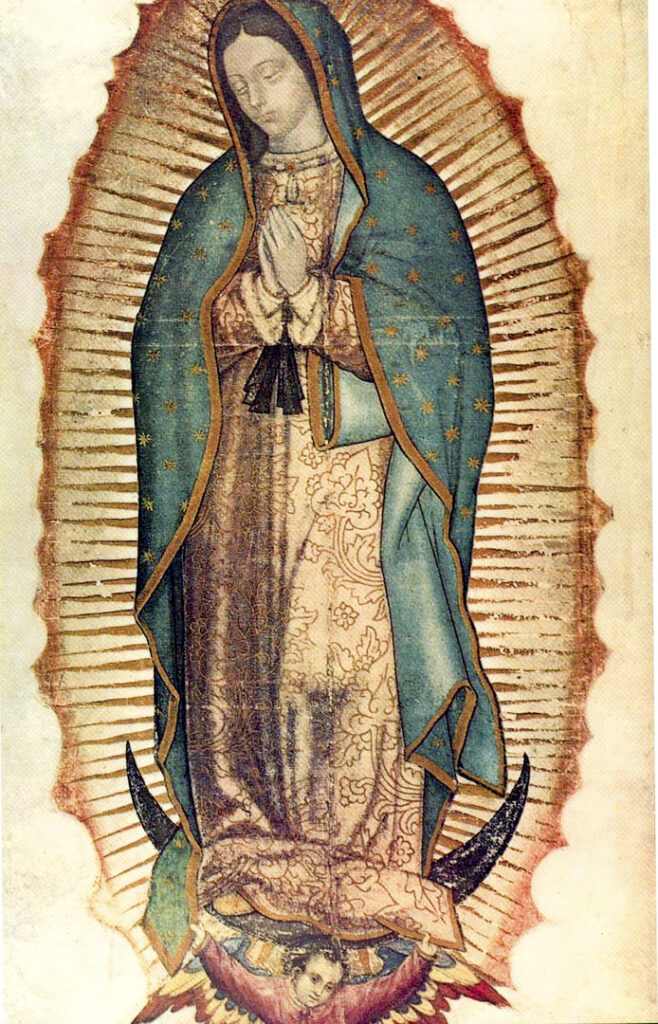
The image of Guadalupe communicated through symbols familiar to both Indigenous people and Christians. It became a visual catechesis capable of crossing linguistic and cultural barriers.
The precise interpretation of every visual detail should be approached carefully. Some explanations are supported by historical and cultural evidence; others belong to later devotional reflection. The Church’s faith does not depend upon every popular scientific or symbolic claim associated with the tilma.
The lasting theological message is clear: Mary is not a goddess. She is the humble Mother of the incarnate Son of God, clothed with the light of Christ and directing the nations toward him.
The Woman Standing Before the Sun
The radiant light surrounding Mary resembles the woman “clothed with the sun” in Revelation (Rev 12:1).
For Christian faith, Mary does not possess light independently. She reflects the glory of God, just as the moon reflects the light of the sun. Her greatness comes from grace.
To Indigenous observers, the figure standing before the sun could communicate that she was greater than the created powers they had worshipped, while not herself claiming to be the supreme God.
Her bowed head, joined hands, and prayerful posture show that she is subject to God.
The Moon Beneath Her Feet
Revelation describes the woman with the moon beneath her feet. The Guadalupe image likewise presents Mary standing upon a dark crescent.
The moon was associated with cosmic and religious symbolism in Indigenous cultures. Mary’s position above it indicates that created powers are not gods.
From a Christian perspective, the image also recalls victory over darkness and instability. Mary stands firmly because God’s grace sustains her.
The Mantle of Stars
Mary wears a blue-green mantle decorated with stars. The color was associated with dignity and nobility, while the stars suggest heaven.
The image proclaims that Mary comes as a heavenly messenger and queenly mother. Yet she remains humble and prayerful.
The stars also recall the crown of twelve stars in Revelation. The number twelve symbolizes the people of God: the twelve tribes of Israel and the twelve apostles.
Mary is both daughter of Israel and motherly image of the Church.
The Rose-Colored Garment
The rose or earth-colored garment connects Mary with the human world. She is not a spirit or goddess but a human woman.
The contrast between the earthly-colored garment and the starry mantle can be read as an image of her vocation at the meeting point of heaven and earth.
In her womb, the eternal Son truly assumes human nature. The one whom heaven cannot contain becomes incarnate within the Virgin.
The Black Maternity Sash
The dark ribbon tied above Mary’s waist was recognized in Indigenous culture as a sign of pregnancy.
Our Lady of Guadalupe therefore appears as a mother carrying a child. This has contributed to her widespread veneration as a patroness of unborn children and a defender of human life.
The child in her womb is Jesus Christ, the true God who becomes truly human. The image proclaims the dignity of life within the womb and the mystery of the Incarnation.
The United States Conference of Catholic Bishops has highlighted Guadalupe as a reminder of the inviolable dignity of every human life and of the unity of all people in Christ. USCCB reflection on Our Lady of Guadalupe
The Four-Petaled Flower
A four-petaled flower appears on the garment over Mary’s womb. Some scholars associate this symbol with Indigenous representations of the center of the universe, divine presence, or cosmic harmony.
Placed over the unborn Christ, it communicates that the child within Mary is the center of creation and the true Lord of heaven and earth.
The visual message corresponds to Catholic faith: Jesus is not one deity among many. He is the eternal Son through whom all things were created (Jn 1:1–3).
Mary’s Joined Hands
Mary’s hands are joined in prayer. Her head is bowed and her eyes are lowered.
These details make clear that Mary is not presenting herself as God. She worships God and submits to his will.
Her prayerful posture reflects her words at the Annunciation:
“May it be done to me according to your word” (Lk 1:38).
Authentic Marian devotion follows the direction of her hands and gaze toward God.
The Cross on Mary’s Brooch
A small cross appears on the brooch at Mary’s neck. The cross points toward Jesus Christ and his saving sacrifice.
Mary’s mission is inseparable from the Cross. She gave Christ his human nature, accompanied him in faith, and stood near him at Calvary.
The image does not end with Mary. It leads to the incarnate and crucified Lord.
The Angel Supporting the Image
An angel appears beneath Mary, supporting the edge of her mantle and garment. His wings bear vivid colors.
The angel emphasizes that Mary’s mission comes from heaven. He also visually joins the heavenly mantle and earthly garment, supporting the woman who carries the divine Son in human flesh.
Mary remains greater than the angel because she is the Mother of the Lord, yet her greatness comes entirely from God.
The Face of Our Lady
The face of Our Lady of Guadalupe reflects a blending of Indigenous and European features. This has made the image a powerful sign of unity among peoples who were living in conflict.
Mary does not appear as the exclusive possession of one race or social class. Her maternal presence crosses divisions.
Her lowered eyes convey humility, tenderness, and compassion. She does not gaze down with domination but looks upon suffering people with maternal concern.
The Tilma and Scientific Claims
The tilma has endured for centuries and remains an extraordinary object of devotion and study. It survived difficult environmental conditions and a bomb explosion near the image in 1921.
Various scientific and popular claims have been made regarding the fabric, pigments, temperature, stars, and reflections in the eyes. Some researchers have proposed remarkable explanations, while others have disputed their methods or conclusions.
Catholic faith in the Guadalupe event does not require acceptance of every scientific claim circulated in devotional literature. Such claims should not be presented as established Church teaching unless they have been adequately verified.
The Church’s emphasis rests upon the spiritual fruits: conversion, reconciliation, prayer, defense of human dignity, and renewed faith in Jesus Christ.
Verse-by-Verse / Phrase-by-Phrase Reflection
“God’s temple in heaven was opened”
The opening of the heavenly temple reveals God’s presence and saving action. Heaven is not closed to humanity. Through Christ, God enters human history and opens the way to communion with him.
The Guadalupe event occurred when many people felt abandoned, oppressed, and disoriented. Mary’s appearance assured them that heaven had not forgotten their suffering.
“The Ark of his Covenant could be seen”
The Ark of the Covenant represented God’s presence among Israel. It contained signs of the covenant and accompanied God’s people.
Mary is understood as the Ark of the New Covenant because she carried Jesus, the eternal Word, true Bread from heaven, and eternal High Priest.
The reference to the Ark immediately before the appearance of the woman supports the Church’s Marian reading of the passage.
“A great sign appeared in the sky”
The woman is called a sign. A sign points beyond itself.
Mary always points beyond herself to Christ. Devotion becomes distorted if it stops with Mary instead of leading to faith, worship, and obedience to her Son.
The Guadalupe image is powerful because it communicates Christ through Mary.
“A woman clothed with the sun”
The woman is surrounded by heavenly glory. Applied to Mary, this image expresses the grace with which God clothed her.
Mary’s radiance is reflected light. Christ is the true light of the world (Jn 8:12).
The Church is also called to be clothed with Christ and to reflect his light before the nations.
“With the moon under her feet”
The woman stands above the changing moon, suggesting victory over darkness, instability, and created powers falsely treated as divine.
Mary’s stability comes from her faith. She stands because she trusts God’s promise.
Christians likewise overcome fear not through personal strength but by standing upon the grace of God.
“On her head a crown of twelve stars”
The twelve stars represent the fullness of God’s covenant people. The woman symbolizes Israel, Mary, and the Church in their relationship to the Messiah.
Mary stands where Israel and the Church meet. She is the daughter of Israel who gives birth to Christ and the motherly image of the Church that brings Christ to the nations.
“She was with child”
The woman carries the promised Messiah. Our Lady of Guadalupe also appears pregnant.
God does not save humanity from a safe distance. The Son enters the vulnerability of the womb, accepts human development, and shares our condition.
Every unborn child possesses dignity, not because of social usefulness, health, or the wishes of others, but because human life is God’s gift.
“She cried aloud in pain”
The woman’s labor symbolizes the suffering involved in bringing forth the Messiah and forming God’s people.
Mary experienced sorrow, misunderstanding, exile, and the sword that pierced her heart. The Church likewise labors to bring Christ to a resistant world.
Evangelization requires patience, sacrifice, and perseverance.
“A huge red dragon”
The dragon represents Satan and the forces that oppose God. Evil attempts to destroy the Messiah and persecute his people.
The dragon operates through violence, deception, idolatry, injustice, and the destruction of innocent life.
The Guadalupe message confronts the dragon wherever human beings are sacrificed to power, wealth, ideology, racism, or fear.
“The dragon stood before the woman”
Evil is threatening, but it is not equal to God. The dragon cannot defeat the divine plan.
Mary’s apparent weakness contrasts with the dragon’s violence. Yet the child she bears is the victorious King.
God’s power works through humility, faith, maternity, and sacrificial love.
“She gave birth to a son”
The male child is Christ, who fulfills the messianic promise. He is the center of Revelation and the center of the Guadalupe image.
Mary’s importance arises from her relationship with Jesus. She is honored because she is his mother and faithful disciple.
“Her child was caught up to God and his throne”
This summarizes Christ’s victory, Resurrection, and Ascension. The child threatened by evil reigns with God.
The Cross did not end Christ’s mission. Apparent defeat became victory.
The persecuted Church therefore lives in hope.
“The woman herself fled into the desert”
The desert can represent trial, purification, dependence, and divine protection. Israel was formed in the desert, and the Church often experiences wilderness conditions.
Many Indigenous people in sixteenth-century Mexico felt that their world had become a desert. Guadalupe assured them that God could prepare a place of grace even amid upheaval.
“Now have salvation and power come”
The final proclamation makes clear that salvation belongs to God and his Anointed.
Mary does not replace Christ. She announces that his Kingdom has come and invites people to receive him.
Every Marian feast should conclude in stronger faith in Jesus.
Jewish and Biblical Context
Revelation draws heavily upon Old Testament imagery. The woman recalls Eve, Israel, Zion, and the mother of the Messiah. The dragon recalls the serpent of Genesis and the monsters representing the powers of chaos and oppression.
The twelve stars evoke the twelve tribes of Israel. The male child destined to rule the nations reflects the royal Messiah of Psalm 2. The wilderness recalls the Exodus, where God protected and nourished his people.
The Ark contained the tablets of the covenant, manna, and Aaron’s priestly staff according to biblical tradition. Mary carries Jesus, the living Word, the Bread of Life, and the eternal High Priest.
The Visitation Gospel also contains Ark symbolism. David asked how the Ark could come to him, while Elizabeth asks why the mother of her Lord should come to her. The Ark remained three months in the house of Obed-edom, and Mary remained about three months with Elizabeth (2 Sm 6:9–11; Lk 1:56).
Catholic Tradition and Teaching
Catholics worship God alone. Mary receives veneration because of God’s grace and her unique relationship with Christ. Her maternal intercession always depends upon the one mediation of Jesus.
The Church distinguishes public revelation from private revelation. Public revelation, contained in Scripture and Apostolic Tradition, reached its fullness in Jesus Christ and binds the whole Church.
Approved Marian apparitions do not add new doctrines to the faith. They help the faithful live the Gospel more fully in particular historical circumstances.
The Guadalupe apparitions communicate established Christian truths:
- Jesus Christ is true God and true man.
- Mary is the Mother of God.
- God shows special concern for the poor and marginalized.
- Human life in the womb possesses sacred dignity.
- The Gospel can enter and transform every culture.
- Evangelization must respect human dignity and freedom.
- Mary’s maternal intercession leads people toward Christ.
- The Church must work for reconciliation among peoples.
Our Lady of Guadalupe and Evangelization
The Guadalupe event had a decisive effect upon evangelization in the Americas. The image communicated the Gospel within Indigenous cultural forms and helped many people approach the Catholic faith.
The Church does not praise coercion or the misuse of political power in evangelization. Authentic conversion must arise from grace and a free response of faith.
Our Lady’s method is maternal. She speaks the people’s language, respects their dignity, adopts understandable symbols, and entrusts her message to one of their own.
Saint John Paul II declared that Guadalupe’s influence extends beyond Mexico and called her Queen of all America. Ecclesia in America
Saint Juan Diego as a Lay Missionary
Juan Diego did not receive Holy Orders, yet he became an effective evangelizer. He carried Mary’s message, persevered despite rejection, cared for the shrine, spoke with pilgrims, and directed people toward Christ and the Church.
His mission demonstrates the indispensable vocation of the laity. Lay Catholics enter homes, workplaces, schools, professions, cultures, and social relationships that ordained ministers may not easily reach.
Effective lay missionaries know the language, struggles, and culture of the people. Their witness can open hearts because it arises from shared experience.
Parishes should form and empower laypeople as catechists, family ministers, youth leaders, digital evangelizers, charitable workers, and witnesses in public life.
Mary and the Dignity of Indigenous Peoples
Mary entrusted her message to an Indigenous man at a time when many people treated Indigenous communities as inferior. She addressed Juan Diego with tenderness and confidence.
God’s choice of Juan challenges racism, class prejudice, cultural superiority, and the tendency to ignore those without social influence.
Mary did not ask Juan to become culturally European before serving Christ. The Gospel took visible form through his language, clothing, and cultural world.
The Church must continue to proclaim that every culture contains values capable of receiving the Gospel, and every people deserves to encounter Christ without losing its legitimate identity.
Mary and the Protection of Unborn Life
Our Lady of Guadalupe appears as a pregnant mother. She carries the unborn Jesus, whose divine and human identity is already fully real.
Her image speaks to societies in which unborn children can be treated as problems, possessions, or disposable lives.
Defending unborn life must be accompanied by compassionate care for pregnant women, fathers, families in crisis, children with disabilities, and mothers who have experienced abortion.
Mary’s maternal presence calls the Church to unite truth with mercy and moral conviction with practical support.
Historical or Saintly Illustration
Saint John Paul II had a profound devotion to Our Lady of Guadalupe. He visited her shrine, entrusted the Americas to her maternal care, and canonized Juan Diego there in 2002.
By raising Juan Diego to the honors of the altar, the Church presented an Indigenous layman as a model for all Christians. His holiness did not depend upon social status, advanced education, or ordained ministry.
He listened, obeyed, persevered, cared for a sick relative, and faithfully communicated the message entrusted to him.
His life shows that an ordinary believer can become an extraordinary instrument when he allows God to work through humility.
Application to Christian Life Today
Our Lady of Guadalupe challenges the Church to examine how she communicates the Gospel. Correct doctrine must be communicated in a language people can understand and through relationships that demonstrate genuine love.
Parents must translate faith into family life. Catechists must communicate doctrine according to the age and experience of students. Priests must know the people they serve. Parishes must welcome immigrants and respect legitimate cultural diversity. Digital evangelizers must combine accuracy with charity.
Guadalupe also calls us to reconciliation. Political, racial, cultural, and economic divisions cannot be allowed to determine whom we respect or welcome.
Like Bishop Zumárraga, Church leaders must discern claimed revelations carefully. Like Juan Diego, believers must persevere without resentment when discernment takes time.
Like Mary, the Church must remain close to people who are grieving, displaced, frightened, or forgotten.
Eucharistic Connection
Mary of Guadalupe carries Jesus within her womb. The same Christ whom she carried becomes sacramentally present in the Holy Eucharist.
At the Visitation, Mary brought the hidden Christ into Elizabeth’s home, and his presence produced joy and the action of the Holy Spirit. After receiving Holy Communion, we are also called to carry Christ into our families and communities.
The Basilica of Our Lady of Guadalupe does not exist merely to display an extraordinary image. It exists above all as a place where the Word is proclaimed, the Eucharist is celebrated, sinners are reconciled, and the suffering encounter Christian hope.
Mary always leads the faithful to the altar of her Son. Authentic devotion to Guadalupe should deepen participation in the Holy Qurbana, love for Scripture, confession of sins, service to the poor, and protection of human life.
Messages / Call to Conversion
- Receive Mary’s maternal message as an invitation to encounter Jesus Christ.
- Trust that God remains near during cultural conflict, social upheaval, and personal suffering.
- Repent of racism, class prejudice, and contempt for Indigenous or immigrant communities.
- Respect the dignity of every human life from conception to natural death.
- Combine defense of unborn life with practical support for mothers and families.
- Communicate the Gospel in language and forms people can understand.
- Recognize and form lay Catholics as essential partners in evangelization.
- Persevere in faith when Church discernment or pastoral progress takes time.
- Approach popular scientific claims about sacred objects with both faith and responsible judgment.
- Carry the Eucharistic Christ to others through humility, reconciliation, and service.
Outline for Preachers
- Historical situation of Mexico after the conquest
- Difficulties facing Indigenous peoples and missionaries
- Juan Diego as a humble Catholic layman
- Apparitions from December 9–12, 1531
- Mary’s request for a church at Tepeyac
- Bishop Zumárraga’s prudent discernment
- Juan’s concern for his sick uncle
- Mary’s maternal reassurance
- Roses and the image upon the tilma
- Guadalupe as inculturated evangelization
- Woman clothed with the sun in Revelation
- Mary, Israel, and the Church in biblical symbolism
- The Ark of the Old and New Covenants
- The dragon as the power of evil
- Christ as the victorious male child
- Maternity sash and dignity of unborn life
- Joined hands and Mary’s submission to God
- Indigenous symbolism and Christ-centered interpretation
- Distinction between Church teaching and later devotional claims
- Saint Juan Diego as a model lay missionary
- Mary’s role in reconciliation among peoples
- Catholic teaching on approved private revelation
- Application to immigrants, cultural diversity, and evangelization
- Eucharistic encounter and carrying Christ to others
- Call to conversion, human dignity, and missionary service